This post revisits a simple idea from our ICLR 2021 paper: most graph convolutions can be understood as filters on graph signals, and filters on graph can be reimplemented as convolution operators. This point of view helps connect spectral and spatial GNNs, and explains why many popular models behave similarly.
Historically, graph convolutions were defined either in the spectral domain (via the Laplacian) or in the spatial domain (via neighborhood aggregation). In practice, both describe the same object: an operator acting on node features.
Let’s start with a simple example: the Karate Club graph. Spring layout of the graph.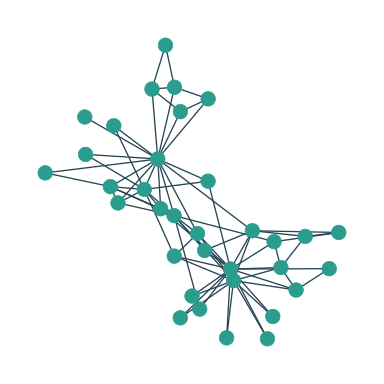
Graph structure
From this graph, we can compute its adjacency matrix, and from the adjacency its (normalized) Laplacian.
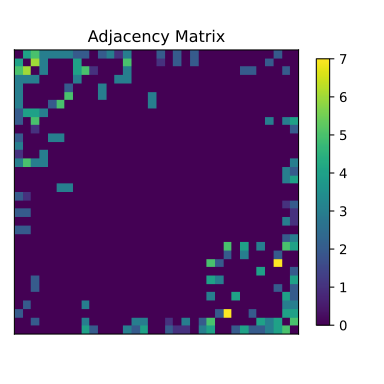
Adjacency matrix
Neighborhood structure in matrix form.
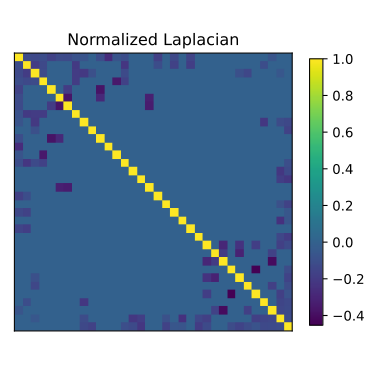
Normalized Laplacian
The operator defining frequencies on graphs.
From a spectral perspective, signals on this graph can be decomposed into eigenmodes of the Laplacian. A graph convolution then acts as a filter over these frequencies.
For instance, early spectral GNNs (Bruna et al., 2014; Henaff et al., 2015, or ChebNet) define convolutions as
$$ H^{(l+1)} = \sigma\big(U \Phi(\Lambda) U^\top H^{(l)} W^{(l)}\big), $$
where $\Phi(\Lambda)$ controls which frequencies are kept or suppressed. When applied on Karate Club, these filters typically emphasize smooth (low-frequency) components.
Now consider spatial GNNs such as GCN, GIN, or GAT. They are usually written as message passing rules, operating directly on the adjacency matrix :
$$ H^{(l+1)} = \sigma\big(\tilde{D}^{-1/2} \tilde{A} \tilde{D}^{-1/2} H^{(l)} W^{(l)}\big). $$
At first glance, they look different : one is using the eigendecomposition of Laplacian, the other one the adjacency matrix. But given the relationship between adjacency and Laplacian matrices, we may look for a correspondance. Indeed, if we inspect what these operators do on node features, we observe the same behavior: they mostly keep low frequencies and smooth the signal.
So these models look different, but behave similarly.
The natural question is: how do we go from one view to the other?
From Spectral Filters to Spatial Kernels
Following the Theorem 1 in Balcilar 2021, given Laplacian eigenpairs $(\lambda_i, u_i)$, any spectral profile $\Phi(\lambda)$ defines a spatial operator
$$ C = U \operatorname{diag}(\Phi(\boldsymbol{\lambda})) U^\top, $$
which leads to the standard update
$$ H^{(l+1)} = \sigma\big(C H^{(l)} W^{(l)}\big). $$
Here, the matrix $C$ acts as a convolution operator, replacing the classic adjacency matrix $A$. Using this spectral to spatial framework, one can then define filters in the spectral domain and apply them in the spatial domain.
import numpy as np

def spectral_to_spatial(U, lambdas, phi):
    return U @ np.diag(phi) @ U.T
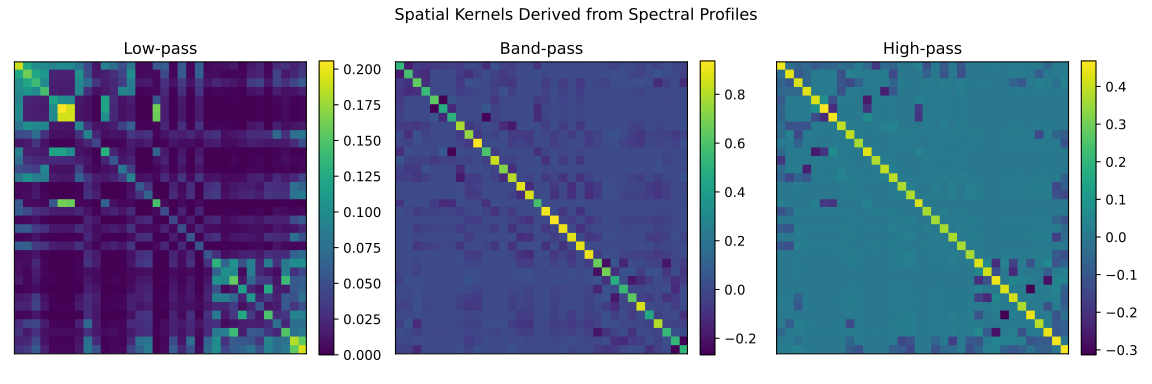
Using these defined spectral profiles :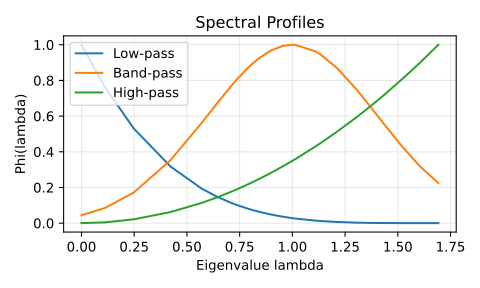
lead to the following spatial convolutional operators:
From Spatial Supports to Frequency Responses
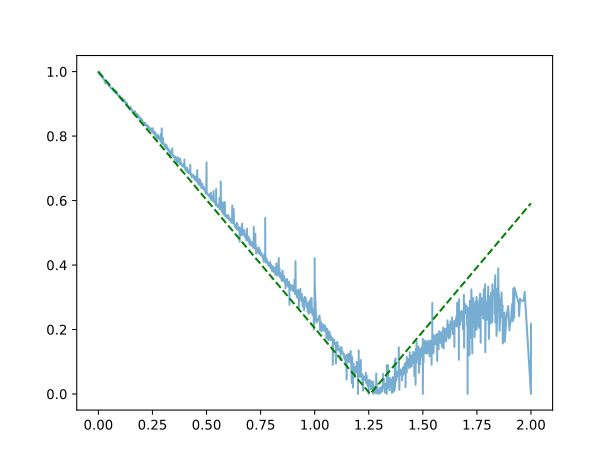
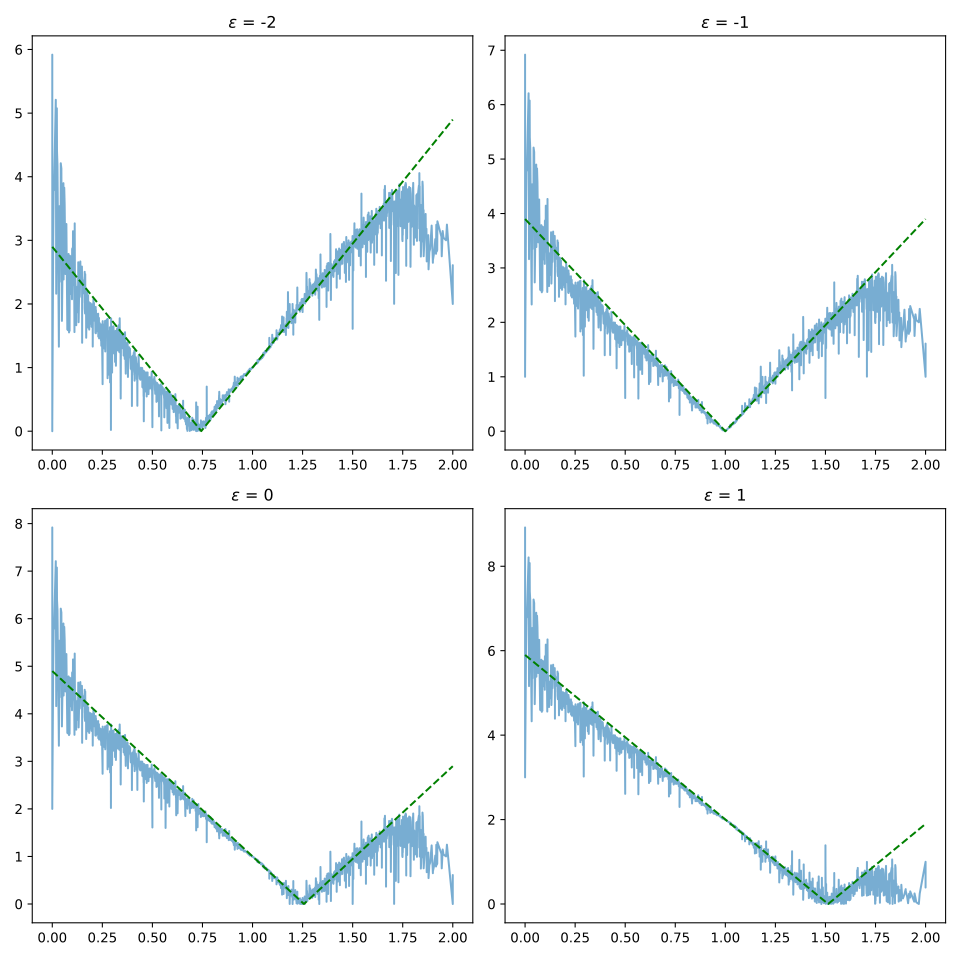
Conversely, we can also pass from a spatial operator to a spectral one, using the Corollary 1.1 in Balcilar 2021. given a spatial kernel $C$, its frequency response is defined as
$$ \Phi(\boldsymbol{\lambda}) = \operatorname{diag}\big(U^\top C U\big). $$
Such relationship allows the study of spatial GNNs in terms of spectral filtering.
def spatial_to_spectral(U, C):
    return np.diag(U.T @ C @ U)
Under this lens, many popular GNNs turn out to be low-pass filters. They smooth node features across edges, which explains their success on homophilous graphs.
Takeaway
These two relations form the spectral<->spatial bridge. Graph convolutions are not just aggregation rules. They are filters, and their spectral profile largely determines their behavior.
Understanding this dual view helps both to analyze existing models and to design new ones.
Code
All figures and experiments can be reproduced from the code available on GitHub.
Reference
Balcilar et al., Analyzing the Expressive Power of Graph Neural Networks in a Spectral Perspective, ICLR 2021.